Irritable Bowel Syndrome (IBS)

Irritable Bowel Syndrome (IBS) dietitian: your step towards a calmer gut

Do you often experience abdominal pain, bloating, or irregular bowel movements? Irritable Bowel Syndrome (IBS) may be the cause. Discover how the specialized IBS dietitians at Samen Sterk guide you personally—with practical advice, proven effective approaches, and, above all, a deep understanding of your situation. Read below what you can expect from us and how your first small step can already make a difference.


  • Personalized nutritional advice, fully tailored to your symptoms and lifestyle.
  • Effective guidance with the FODMAP diet or other evidence-based approaches.
  • Motivating, accessible support with attention to you as a person.
Dietistenpraktijk Samen Sterk

What is Irritable Bowel Syndrome (IBS)

Irritable Bowel Syndrome (IBS) is a disorder of bowel function, especially of the large intestine. It is a chronic condition; if you have it, you will need to learn how to live with it. A dietitian can help you with this.

If you have IBS, your intestines may move too much or too little. Your intestines contain many nerves. In IBS, these nerves are overly sensitive to the movements in your intestines. As a result, you may experience various unpleasant symptoms.

The dietitians at My Dietitian Online specialize in the treatment of Irritable Bowel Syndrome (IBS), also known as a spastic colon.

Relieving IBS symptoms

Below we explain what IBS is and how a dietitian can help you get rid of your symptoms and rule out underlying diseases/conditions.

Adjusting your diet helps reduce and/or eliminate IBS symptoms. Because it works differently for everyone, it is important to work with a dietitian to determine which adjustments are suitable for you. This helps prevent nutrient deficiencies and an unbalanced diet.

*Approximately 10% of the population experiences Irritable Bowel Syndrome to a greater or lesser extent.

Make an appointment for your online consult

Start your journey and take the first step with an introductory appointment

Causes of Irritable Bowel Syndrome

It is not always clear how IBS develops. It is noticeable that women experience IBS symptoms more often than men. Stress may play a role, as well as certain foods, a gut or stomach infection, or an allergy. It is therefore important to consider these possible causes during treatment. There is a connection between the brain and the gut; when you experience stress, IBS symptoms may worsen. This includes reducing stress, but also adjusting your diet. Sometimes this is not enough and symptoms persist. In that case, it may help to analyze your diet for FODMAPs with the guidance of a dietitian.

Our approach

Personal approach

1

Dietistenpraktijk Samen Sterk

You contact us

You contact us and pay directly for the appointment online.

2

Dietistenpraktijk Samen Sterk

We can start

We contact you and schedule an appointment with the dietitian to officially start the program.

Prikkelbare Darm Syndroom

Symptoms of Irritable Bowel Syndrome

You can recognize Irritable Bowel Syndrome (IBS) by the symptoms listed below.

Please note! Not everyone notices symptoms when they have IBS. They can occur in varying degrees. Experiencing more than one symptom may indicate Irritable Bowel Syndrome.

Many IBS symptoms can overlap with other conditions, such as celiac disease, lactose intolerance, or chronic intestinal inflammation. It is therefore important to seek guidance from a dietitian to ensure the correct diagnosis!

Most common symptoms of Irritable Bowel Syndrome:

  • Bloating
  • Constipation
  • Diarrhea
  • Abdominal pain
  • Abdominal cramps
  • Flatulence
  • Fatigue
  • Nausea
  • Heartburn

* Symptoms worsen with stress and tension.

What can you do?

Only a dietitian can work with you to determine whether you have Irritable Bowel Syndrome!
This can only be assessed through the FODMAP diet.

The FODMAP diet can help you fully recover from your symptoms. It is crucial not to follow this diet on your own, but with the guidance of a dietitian. The dietitian ensures that you do not develop nutrient deficiencies, that your body is not negatively affected in the long term, and that your immune system remains strong. The dietitian is specialized in the FODMAP diet and knows exactly which steps are needed to support you as effectively as possible.

Diëtist prikkelbare darm syndroom

Je kunt ons kennen van…

Je kent ons van
PDS Prikkelbare darm Syndroom

What does a dietitian do for IBS?

Following a low-FODMAP diet starts with eliminating foods that are high in FODMAPs. This phase lasts 6 to 8 weeks. Your dietitian will explain which foods are allowed and which are not. Despite these restrictions, the dietitian ensures that your diet remains nutritionally adequate. They will also help you with reading food labels.

After the elimination phase, FODMAPs are gradually reintroduced into your diet one by one. The dietitian will guide you on what you can eat again and in what quantities. Often, IBS involves a sensitivity to one or more FODMAP groups. With the help of your dietitian, you will learn which FODMAPs and how much you can tolerate. In practice, it is seen that when people follow this diet on their own, they often stay in the elimination phase for too long. This can lead to an unbalanced diet and may even cause additional symptoms.

Your dietitian is your nutrition coach

When you sign up with us, we schedule an intake as soon as possible. During the intake, we take the time to gain insight into your situation and health. Where are you now and, more importantly, where do you want to go? What are your goals and needs, as well as your limitations. During the intake, we review your eating pattern: what do you eat, when, and how much? We also look at why you make certain choices. In addition to nutrition, we consider other lifestyle factors such as physical activity, sleep, and stress. These factors also influence your eating habits and overall health. After that, we create a personalized plan. This advice is practical, personal, and achievable for you. You may still have many questions during the first consultation—we take the time to answer them. During the process, we coach you step by step toward a healthier lifestyle. Your dietitian advises and motivates you, even when things get a bit more challenging.

Your dietitian:

  • listens to your wishes and needs
  • involves you in setting your goals
  • explains anything you have questions about
  • always provides tailored advice
  • motivates you, regardless of how you are doing
  • coaches you toward a healthier lifestyle, in small or larger steps

Your dietitian helps you get on track, so that you learn how to live a healthy and comfortable life and grow older in a vital way.

Diëtist omgeving Haarlem

Our approach: step by step toward less discomfort in your gut

How does the guidance process work?

  • Intake and analysis: we assess your symptoms, habits, and dietary pattern.
  • Advice: you receive a clear plan, sometimes including the FODMAP diet, always tailored to your situation.
  • Practical tools: such as shopping lists and sample recipes.
  • Guidance: we regularly review your progress, adjust the advice, and provide extra motivation when needed.
  • Evaluation and maintenance: we ensure sustainable changes and remain available for questions, even after your program.

At My Dietitian Online, we combine nutrition with lifestyle advice related to stress, sleep, and physical activity. Thanks to accessible video consultations or appointments at one of our locations, you will quickly feel supported. You often notice the first improvements within the first few weeks!

What is the FODMAP diet?

The low-FODMAP diet

At Monash University in Australia, a diet has been developed that has proven to be effective for IBS. This is the low-FODMAP or restricted FODMAP diet. The diet is quite strict, but it has been shown that 75% of people with IBS experience significantly fewer or even no symptoms.

What does FODMAP stand for?

FODMAP is an abbreviation. Each letter represents a group of carbohydrates that are known from research to cause symptoms. FODMAP stands for: Fermentable Oligosaccharides, Disaccharides, Monosaccharides, And Polyols. These nutrients are further divided into:

  • Fructose (found in many types of fruit)
  • Fructans (found in products made from wheat, rye, barley, and some vegetables)
  • Lactose (found in dairy products)
  • Galactans (found in legumes and some nuts)
  • Polyols (found in sweeteners and some fruits and vegetables)
Diëtist omgeving Haarlem
FODMAP-dieet

FODMAP diet approach

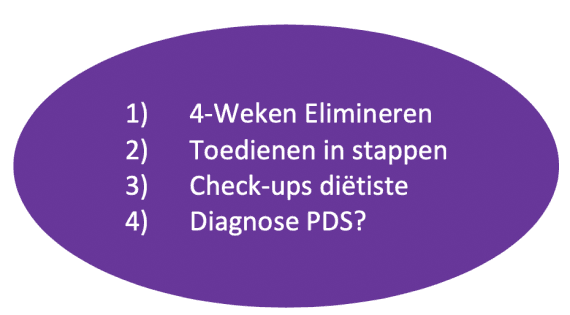
1. No FODMAP foods for 4–6 weeks
You will receive a list from your dietitian indicating which foods this includes.
Strict adherence is essential! Otherwise, the test will not work to determine whether you have IBS.

2. Then follow a schedule where you reintroduce foods one by one per FODMAP group to see what you react to.
It is a complex diet that should be properly guided by a dietitian.

3. You may quickly develop nutrient deficiencies; the dietitian will prevent this with regular check-ups.

4. After testing, your dietitian can determine whether you have IBS.
This conclusion is based on the eliminated FODMAP foods.

Why is it necessary to limit FODMAPs?

In people with IBS, FODMAPs are often not properly absorbed in the intestines. When they reach the large intestine, they are fermented by bacteria, which produces gas. For someone without IBS, this is not a problem and does not cause symptoms. However, in people with IBS, this can lead to bloating, abdominal cramps, and flatulence. By (temporarily) eliminating FODMAPs, these symptoms can be reduced.

Who is the low-FODMAP diet suitable for?

The low-FODMAP diet is suitable for people with IBS symptoms who have already followed a regular eating pattern with sufficient dietary fiber, fat, and fluids, combined with adequate physical activity, but for whom this has not been effective. By following the low-FODMAP diet together with a dietitian, symptoms can be reduced.

*Research has shown that approximately 75% of people with IBS experience significantly fewer symptoms with the low-FODMAP diet.

FODMAP Dieet

FODMAP scientifically researched

At the Martini Hospital in Groningen, research into the effects of the FODMAP diet has been conducted since 2013. Data is available from 50 people with IBS, of whom 38 are women. Two participants dropped out, but among the remaining 48, 84% experienced moderate to significant symptom improvement. By reintroducing FODMAPs, researchers gained better insight into which FODMAPs were not well tolerated. These findings are consistent with international studies, where 70–87% of participants reported clearly reduced symptoms after following a low-FODMAP diet. It is important that the diet is followed under the guidance of an experienced dietitian.

Veelgestelde vragen

What should you not eat with Irritable Bowel Syndrome (IBS)?

There is no general “forbidden” food, but FODMAPs (fermentable carbohydrates) often cause symptoms. A dietitian can help you use the FODMAP diet to determine which specific foods you should temporarily eliminate and in what amounts you can tolerate them again.

Which foods help calm the intestines?

Food that calms the intestines is highly individual, but avoiding symptom-triggering FODMAPs can help bring relief. A balanced and varied diet with sufficient fluids and dietary fiber forms the foundation.

What is best to eat if you have Irritable Bowel Syndrome (IBS)?

It is best to follow a personalized nutrition plan created by a dietitian, often based on a low-FODMAP diet. This ensures you eat a balanced diet and learn which foods your intestines can tolerate.

What does a dietitian do for IBS?

A dietitian guides you through the FODMAP diet (elimination and reintroduction phases) to identify which foods trigger your symptoms. They ensure your diet remains balanced, provide lifestyle advice, and teach you how to read food labels.

Can dietitians help with Irritable Bowel Syndrome (IBS)?

Yes, a dietitian is essential in managing IBS. Research shows that 70–87% of IBS patients experience fewer symptoms when following the FODMAP diet under professional guidance. Dietitians help ensure an accurate diagnosis and prevent nutritional deficiencies.

Book an online appointment

Please fill in the form and pay for the appointment online. We will then contact you as soon as possible to schedule an online consultation.

Pakketten